Why a proven organisational model is more relevant than ever in the age of artificial intelligence.
In brief
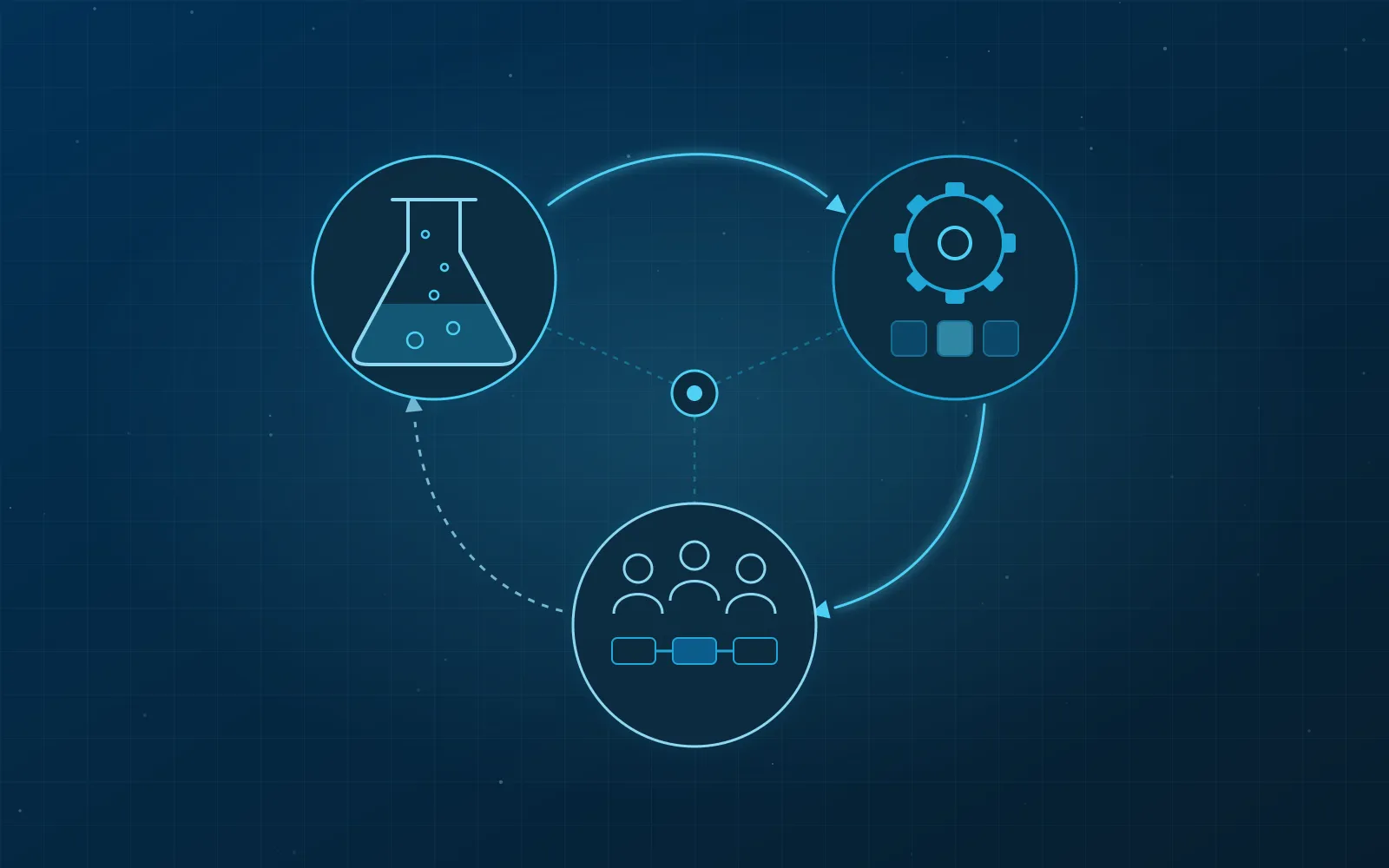
A few years ago I developed a model that looks at the digitalisation of companies from three perspectives: Digital Office, Digital Factory and Digital Lab.
With the arrival of artificial intelligence, this model matters even more. AI changes not only which technologies we use, but also how we solve problems, shape organisations and pursue innovation.
- Digital Office: People, processes and organisational structures have to evolve. What counts is questioning existing ways of thinking and understanding new possibilities.
- Digital Factory: Companies need technological competence of their own to shape their future themselves. AI makes building that competence considerably easier.
- Digital Lab: Innovation and continuous learning have to become part of the organisation. The pace of AI development leaves hardly any room for traditional innovation cycles.
The key insight: AI transformation only works when organisational change, technological competence and continuous innovation work together.
An old model becomes relevant again
When I developed my model of the three digital pillars a few years ago, it addressed a fundamental question: how does a company have to set itself up to actually make use of what digitalisation offers?
Even then it was clear that introducing new software is not enough. Digitalisation affects the whole organisation – its people, its processes, its technological capabilities and its willingness to keep developing.
Today, with artificial intelligence, we face the next change. And much of what mattered then matters even more now.
The essential difference lies in the speed and in the nature of the change.
AI does not just let us do existing work faster. It opens up entirely new ways of solving problems. In doing so, it also challenges assumptions on which we have built our systems, processes and organisations for decades.
This is exactly where the three pillars come in.
1. Digital Office – new technologies require new ways of thinking
Perhaps the biggest challenge of AI transformation is not the technology. It is our habit of solving problems with the methods we already know.
The Digital Office therefore covers three levels: people, processes and organisation.
All three have to evolve. And all three need a basic understanding of what is technologically possible today.
This is not about turning every employee into a software developer. It is about being able to question one's own ways of working critically.
An example: how we think about data and matching
Take a typical task: a company wants to match pieces of information against each other – applicants against job requirements, products against customer needs, or experts against specific questions.
The traditional approach usually starts with a data model. We define categories, tables, attributes and relationships. Then we build forms to capture this information as completely and as structured as possible.
That works – as long as reality matches our model.
In practice, however, requirements evolve. New properties become relevant, additional relationships emerge, terms change their meaning. What was clear at the start becomes increasingly complex.
We extend tables, add fields, rework forms and put ever more effort into maintaining the data structures.
We should ask ourselves a fundamental question:
Do we want to manage the most perfect data structures possible – or do we want the best possible results?
Modern AI opens up other possibilities here. Information can be interpreted semantically, relationships recognised dynamically, and connections taken into account even if they were not known when the system was first designed.
That does not make relational databases, fixed data models or structured processes obsolete. They remain important wherever reliability, consistency and traceability are required.
But we no longer have to model every possible relationship in advance.
The decisive shift is to move away from the existing solution and back towards the actual problem.
When change becomes technically easier
A similar shift is happening in software development.
In many companies, changes to existing systems were long associated with considerable cost, risk and coordination. Even small adjustments could set off large projects.
Today, AI-assisted development, automated testing and modern deployment processes make much shorter development cycles possible.
A prototype that used to take weeks can, under the right conditions, now be built within a few days.
This also changes how we design organisations and processes.
We no longer have to try to anticipate every future requirement in the first design. Instead, we can develop, review and improve solutions step by step.
This, however, creates a new challenge.
Not everyone wants to work in an organisation where everything is constantly changing.
People need orientation, reliable routines and clear responsibilities. New technologies do not make these needs go away.
A successful AI transformation therefore has to make both possible: stability where it is needed, and flexibility where it opens up new opportunities.
That is a leadership task, not a software feature.
2. Digital Factory – technological competence belongs inside the company
The second pillar concerns an organisation's ability to understand, design and develop technological solutions itself.
For many years, outsourcing was a central strategy for many companies. IT services were handed to external providers to cut costs, deploy resources flexibly and buy in specialist knowledge.
In principle, that makes sense.
It becomes a problem, however, when companies outsource not only services but also lose the knowledge of how their own systems work.
Then a dependency arises that goes far beyond technical operations.
If every new idea first has to be assessed, priced and implemented by an external provider, the company loses a significant part of its own ability to shape things.
If you cannot judge the technological possibilities yourself, you can only make strategic decisions independently to a limited extent.
AI changes what in-house IT competence can do
This is precisely where artificial intelligence opens up interesting perspectives.
AI-assisted development tools considerably raise the productivity of technically skilled employees. Small teams can now take on tasks that used to require much larger resources.
That makes building in-house technological competence attractive even for companies that have so far depended heavily on external providers.
My conviction is therefore clear:
Medium-sized and large companies should have enough technological competence of their own to actively shape their business-critical systems and digital business models.
This explicitly does not mean providing all IT services themselves.
It means distinguishing deliberately between strategically relevant competences and standardised services.
What contributes substantially to your own competitiveness you should understand and be able to shape largely yourself. Standardised services can still be sourced efficiently from specialised partners.
What matters is the ability to make these decisions yourself.
And where external partners are needed, it takes long-term, reliable relationships and enough competence of your own to develop solutions together as equals.
The Digital Factory is therefore much more than a development department.
It is the company's technological capacity to act.
3. Digital Lab – innovation becomes a continuous process
The third pillar deals with how companies recognise new possibilities, evaluate them and turn them into concrete improvements.
Traditionally, innovation is often organised as a separate initiative: innovation programmes, annual strategy processes, idea competitions or time-limited projects.
Such approaches can be useful. On their own, however, they are no longer enough for the current development of artificial intelligence.
New models, tools and applications appear at ever shorter intervals. At the same time, competitors are experimenting with the same technologies and looking for new business models.
A company therefore cannot rely on revising its innovation strategy once a year.
The ability to learn continuously becomes a competitive factor in itself.
From innovation project to learning organisation
The Digital Lab does not have to be a building of its own, or even a department of its own.
Rather, it describes an organisational capability: recognising new developments early, testing ideas quickly and using what has been learned systematically.
Above all, this requires three things.
Room for experiments. Employees and teams must be allowed to try out new approaches without every idea immediately turning into a large project.
Short decision paths. Not every question needs a concept that takes months. A limited practical trial often delivers answers faster and more reliably.
Consistent implementation. Insights must not end in presentations or isolated pilot projects. What proves itself has to find its way into the operational organisation.
Deliberately ending experiments is part of success, too. Not every technological possibility creates economic value.
What matters is recognising as early as possible which approaches actually add value.
A working Digital Lab therefore does not create innovation for its own sake. It makes sure the company keeps improving.
Why the three pillars belong together
The strength of the model lies not in the individual pillars but in how they work together.
The Digital Lab identifies new possibilities, examines technologies and develops approaches to solutions.
The Digital Factory has the technical competence to turn them into secure, economical solutions that can be run for the long term.
The Digital Office creates the organisational conditions for these solutions to actually be used and to deliver measurable value.
At the same time, daily work produces new requirements and ideas, which in turn flow back into the Digital Lab.
The result is a continuous development process.
If one of these capabilities is missing, significant potential remains unused.
A company can be excellently positioned technologically and still fail because of its internal structures. It can develop numerous innovative ideas without ever putting them into production. Or it can prepare its employees intensively for change without having the competence to shape that change itself.
Successful transformation therefore needs all three perspectives.
What does this mean for leadership?
In my view, leaders today should spend less time on the question of which AI applications to introduce next.
The more important questions lie one level above:
- Digital Office: Are our people, processes and organisational structures prepared to use fundamentally new approaches?
- Digital Factory: Do we have the technological competence to shape our digital future on our own terms?
- Digital Lab: Can we recognise new developments, try them out and turn them into concrete improvements quickly enough?
These questions do not concern IT departments alone. They concern corporate strategy, organisational development and, ultimately, the whole understanding of leadership.
Conclusion: don't just introduce technology – develop the organisation
Artificial intelligence will change many existing ways of working, processes and business models. How far these changes will go cannot yet be fully assessed.
That makes it all the more important to build organisations that can deal with this development.
For that, companies need people who understand and question new possibilities. They need technological competence of their own to make decisions independently. And they need the ability to experiment, learn and develop continuously.
Digital Office, Digital Factory and Digital Lab provide a common framework for this.
The three pillars were already relevant for digitalisation. With artificial intelligence they become an essential condition for long-term competitiveness.
Because in the end, it is not only the AI technology a company uses that decides.
What decides is how well the organisation is able to turn it into a lasting advantage.